May 23, 2011

Amazing Power of Trees

They are the columns made of Japanese cypress in Horyu-ji Temple which was rebuilt around the beginning of the 8th century and designated as a world heritage site in 1993. The main hall, the five story pagoda and the middle gate in the temple compound  are considered to be the oldest wooden structures in the world.
 the middle gate of Horyu-ji Temple

Take a close look at the column.  This column along with other ones has supported the structures for 1300 years.  It tells us the immense vital power of Japanese cypress as well as the history of the repairs made during 1300 years.

The ancient builders had already known well  the strength of the Japanese cypress - the fittest and strongest natural materials for construction in Japan. It is said that one thousand- year-old cypress will live another one thousand years and two thousand-year-old one will live another two thousand years in the different way after being cut down.  If you touch any of them,  you will feel sensational energy through your hands.

This is one of a pair of Nio Guardians in the middle gate. It looks different as being viewed from the back.

 I'm wondering how long this magnificent building constructed of steel and concrete will continue to exist.
Kyoto Station photoed in December, 2010

In Nara Park, tiny propellers of maple trees are ready to fly.

In the grounds of Kasuga Grand Shrine, there are many old and magnificent camphor trees. It is said that the trees have been considered as divine because of their mysterious smell. People scarcely visit here where this amazing camphor tree stands with dignity.

Though the trunk is completely hollow and  has even  three big holes, amazingly enough  the tree is  growing and thriving.  The inside of the trunk is charred partially. I guess probably these damages were brought by a lightning. The tree looks like a circularly-curved wall.

Looking up to the sky through the hollow.

At dusk, this camphor tree is spotlighted by a setting sun and gently watching the deer browsing as if it were a guardian of them.
Another amazing  camphor tree is  also in the grounds of Kasuga Grand Shrine.  Tree young camphor trees were planted in 1908 and over the years they started to stick together. Now they look like one huge camphor tree.
  
The buds of camphor flowers are going to burst very soon.

My favorite is this Japanese cedar tree in Todai-ji Temple . It seems to show  almost all of its roots on the ground.  The photo is only part of the roots.

 I just look at the immense energy of nature in awe.

               
                                            Visit My World to learn more about our world!!


May 20, 2011

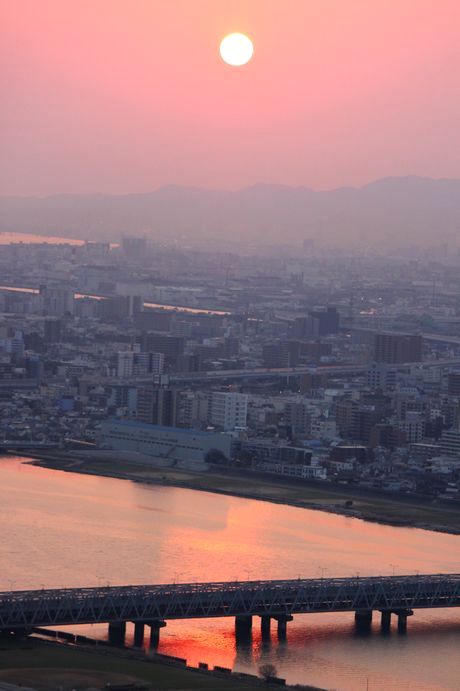
Reflection, Which One Do You Like?

This is the sunset that  I viewed  in Osaka. Every second, the town  was changing its face. Which one do you like the best?


                                                         Click to see the rules and to take a badge for yourself.

May 17, 2011

Paradise of Wisteria・・・

wild wisteria flowers

 Early May, Nara Park becomes the paradise of wisteria flowers where both wild  and caltivated ones are in full bloom.  I love wild wiseria flowers.

This is my secret place to enjoy wild wisteria flowers, which  is part of the grounds of Kasuga Grand Shrine . Crossing a small brook, a gently rolling grass land with the mysterious legends appears before your eyes. Here is the utopia of the deer and wild wisteria.
Now deer are  shedding winter fur.

When Nara was the capital of Japan in the 8th century, the Fujiwaras were the most powerful and rich clan. They expanded their political power through marriage with the Imperial family.  Fujiwara means "Wisteria Field" and they loved wisteria flowers.

However, wisteria trees are doomed that they can not live or  grow without coiling other trees. The tree looks like entire wisteria tree, but the vines of the wisteria are coiling  and squeezing a  big tree and climbing up to the top to  bloom.

The coiling vines of the wisteria look like squiggling  huge snakes. The flowers are very beautiful and the color of the flowers is noble, but under the blooming flowers such quiet struggles have taken place. Maybe these coiling vines of wisteria trees are the legacy to symbolize the ancient power struggles fought among the Fujiwaras and the imperial family and other powerful clans.


This is more than 800 year-old  "Sunazuri-no-Fuji (Touching the Sand Wisteria ) in front of the sanctuary of Kasuga Grand Shrine. This wisteria is very  famous for its long clusters. The clusters are so long that they almost touch the sand or the ground. Last Year, the longest cluster was measured 1.6 meres in length.

 Kasuga Grand Shrine was founded as a guardian shrine of the Fujiwaras, 
so  shrine maidens wear the crown of wisteria.


In Kofuku-ji Temple, a guardian temple of the Fujiwara family

The wisteria season  has already passed and the petals of the flowers are resting on lanterns.

On the way back home, I saw this sunset. The clouds reminded me of feathers of a phoenix.

                             Visit My World to learn more about our world


May 11, 2011

Everything is Melted in Green Breeze

Now, Nara Park is amid the whirlpool of lush verdure of young leaves. The sunlight goes through the fresh leaves and flickers them.

 Camphor trees are shedding old leaves and growing new ones.

 Fallen leaves look like beautiful autumn foliage. None of them has the same color or pattern. Look at green marble-like patterns, I won’t be tired of viewing them!. But most of people are just passing by them.

In the grounds of Kasuga Grand Shrine, there are many old and magnificent camphor trees. It is said that the trees have been considered as divine because of their mysterious smell.  In olden days, people used to make moth balls from camphor trees to protect clothes from moths.

Camphor tree (left big one), wild wisteria and deer


Wild wisteria flowers in sunset. Flowers in May are wisteria, and people enjoy wild wisteria as well as cultivated ones in the park. In the 8th century, the Fujiwaras were the  most powerful and rich clan.  Their favorite flowers were wisteria as Fujiwara means wisteria field.  That's why so many wisteria around Nara Park.
wisteria leaves

The maple leaves which are rimmed with faint red.
They look like open hands of babies.

A thatched house is surrounded with maple trees. It seems as if it were enveloped in green blazes.( related blog is here,Last Flicker of Subtle Beauty, Mizuya-chaya )

This Haiku was composed on the deadly catastrophe which hit Tohoku district on March 11th. The poem was selected and appeared in Asahi Newspaper. Haiku is the shortest Japanese poem consisting of 5-7-5 syllables

ものの芽の 天地裂くとも 萌えいでよ 斉藤哲也

Buds,
Even though heaven and earth were split,
Sprout!
by Saito Tetsuya

Not only leaves but also grasses are gorgeous.
.
Here, people come to enjoy doing nothing.

Deer in early sunset

In sunset

It is hard to introduce all of them. This beauty continues only for a while. The leaves soon grow strong and lose their shy softness and fragileness. I love their fleeting beauty. 

For your reference
Each season has each color. Based on Chinese faith, green or blue represents spring. In olden days, both green and blue were named blue in Japan. No wonder, spring is depicted as green(blue).
Blue or green, spring, 青春
Red, summer、朱夏
White, autumn、白秋
Black, winter、玄冬
Yellow, canicular days 土用

This time, I had hard time to post my blog because of Blogger's  system trouble. I struggled for a long time.  Did n't you have it?(^^;)


                              Visit My World to learn more about our world


May 07, 2011

Everything is Bathed in Green Breeze, Isui-en Garden

This is my favorite Japanese garden in Nara, Isui-en Garden.

As those glasses were made in Meiji(1868-1912) or Taisho(1912-1926) eras, they are not flat or smooth but slightly uneven. So the reflections on them look dim and distorted a little.  I love these subtle images.

The garden is a stroll-through and also borrowed landscape garden. Three mountains and the magnificent roof of Great South Gate of Todai-ji Temple are incorporated to the beauty of the garden. The reflections on the glass sliding doors above is this scenery.

May is the month when we can enjoy the most gorgeous green of young leaves. The leaves show myriad shades of green and twinkle against fresh sunlight of May. The leaves are soft, gentle and fragile. The shining  leaves are reflected on the glass sliding doors. It seems as if they are condensed and frozen inside a house.

                                          
                                               Click to see the rules and to take a badge for yourself.

May 03, 2011

Once Upon a Time, My Town Nara


Once upon a time  the majestic capital of Japan had been in Nara for about 70 years. In 710, the capital, called  "Heijo-kyo",  was established modeling on Changan, Tang Capital of China. At that time, Japan had periodically sent the diplomatic ships for envoys to Tang China and also had close contact with Korea. Japan learned a lot of things from China and Korea such as highly advanced culture, technology and knowledge. This  learning became the foundation of Japanese culture. That's why Nara is said to be home to Japanese culture. As Silk Road connected China and Europe, it is no wonder that  Nara has been called " The Terminal of Silk Road".


Here is  the center of the capital-Heijo Palace Site where the Imperial Palace, the Imperial government hall, other official buildings  used to stand majestically in the 8th century. But when the capital was moved from Nara to Kyoto, all major buildings were dismantled,  transferred to and reassembled in the new capital, Kyoto.  As traditional Japanese buildings are constructed of wood by using the technique of dovetailing, they are easily dismantled. Gradually  this site was abandoned and forgotten. Until the site was recognized as the old palace site in 19th century, it had slept under rice paddies. Now the site is under excavation.
 But, why they moved the capital from Nara to Kyoto? It is said that the new Emperor Kanmu wanted to start the new government in the new capital as too much bloodshed took place because of power struggles in the old capital. The other reason is that the temples in Nara became so powerful that they started to interfere in political matters. Leaving the temples in Nara, the capital was moved to Kyoto. 

Many of the buildings in Nara capital had roofs covered with bluish roof tiles, massive red columns and white walls. Many people  from Asia , Middle East and even Europe(maybe) came to Nara. In the 8th century, Nara was a lively international city.  The short poem of the time described its beauty and glory.

あおによし 奈良の都は 咲く花の
にほふがごとく 今盛りなり

The capital of Nara,
is beautifully flourishing now
like fragrant flowers in full bloom

A small red dot is a flying kite.

Noble people in the 8th century were dressed in Chinese-style clothes.

This is Imperial Audience Hall  which was the center of the Heijo Palace Site.
The hall was the center of the centers.  Here the emperors reigned over Japan. The hall  was rebuilt in 2010.

This is the replica of the chair which the emperors sat down in ceremonial occasions.

This Sujaku-mon Gate was  the main entrance gate to the Imperial Palace Site.
 The gate was guarded by brave soldiers all day long. This gate was  rebuilt in 1988.

It seems that nothing valuable from the 8th century is left in the palace site. Only newly built structures are there. Why was this site designated as World Heritage Site? The answer is that the archaeological treasures lie down underground, such as roof tiles, earthenware, wooden tablets and more which vividly tell us the people's life of the time. This site is nicknamed the underground "Shoso-in" which is the Imperial treasure house in the 8th century.

The festival has been held in the palace site from April 29 to May 5 to collect donations for Tohoku, the badly affected areas.

Visit My World to learn more about our world

April 30, 2011

Reflection, Center of Ancient Japan

 A gentle sunset reflects on the rails of the ancient Imperial Audience Hall.
 Once upon a time Nara had been  the capital of Japan for a short period、from 710 to 784. Imperial Audience Hall was the center of the capital. Here the emperors reigned over Japan. The hall  was rebuilt in 2010.

The Capital was called "Heijo-kyo" whose Palace Site is designated as World Heritage Site. This place is my favorite and  especially I love viewing a sunset from here.


          Click to see the rules and to take a badge for yourself.