February 12, 2012

Most Beautiful Jealousy

This is the saddest story about jealousy described in " Tale of Genji". It was  written by a female writer, Murasaki Shikibu in the 11th century. And this Japanese-style picture of the story depicts the jealousy most beautifully .
 The painting  is titled "焔(ほのお),  Flame" drawn by Uemura Shoen
It depicts Lady Rokujo who is in the extreme jealousy. How beautiful and fierce
 the apparition of jealousy is!  She is biting her hair and tries to suppress
her burning emotions  which seem to emit pale flame.
 ( image taken from google)  

Lady Rokujo is a  mistress of Prince Genji, but she is loosing his love.  She is beautiful, sophisticated, well educated, older than him and a woman of high status who is a widow of the crown prince.   Her tragedy is that she is too perfect to be his mistress.  More over she is too proud to allow her to be jealous or show him her true feelings honestly.


When Lady Rokujo gets to know the wife of Prince Genji is pregnant, she is burnt by strong jealousy. She is at the verge of  loosing sanity. Once she has been humiliated by the servants of his wife in public. She has the deep grudge against his wife. At last, her living soul steals out of  her body and transforms into a female demon. The demon starts to haunt his wife.

Lady Rokujo's soul becomes the demon. (image taken from google)
This is the Noh play.


I can not help feeling pity for her. What the hell  is Lady Rokujo going through? No one can be free from jealousy. Spider nets and wisteria flowers on her kimono tell us eloquently the depth of her sorrow and obsession of her unrequited love. Even how badly she is ashamed at the transformation, she can not do anything.
Does she want to catch his heart with the spider nets. 

Does she want to coil his heart  like wisterias do.
 Wisterias are doomed to coil other trees and grow.

Or her mind is already caught in the spider nets of jealousy and coiled by the grudge.
There is no way for her to go.


It is said in Japan if a woman is so jealous, she transforms to a  female demon with two horns,  which is called Han-nya(般若).  This is a  mask of the female demon used in Noh plays. A mask with separated hair in the middle is a female mask.
Only jealous women, but not jealous men, become the demons . Oh, it is not fair here in Japan!!

Being caught by a green-eyed monster, Othello killed his wife, didn't he??

Do Japanese men want to say to women
"If you are jealous too much, you will become a demon with horns. Be generous to my cheating." No kidding!

Strangely enough, Han-nya (般若) means the wisdom of Buddha to see the truth in Buddhism.  There are a few theories why the female demon is called Han-nya(般若).

In the 16th century, Priest Han-nya carved supreme masks of the female demon. Since then the masks of this kind have been called Han-nya.

Other theory says that to transform into the Han-nya is one path to the salvation led by the prayers of Buddha.

 In a traditional Japanese wedding ceremony, a bride wears "Tuno Kakushi" which literally means "Horn Hide" - a head wear made of a rectangular white silk cloth. This is to give a bride the caution not to have jealous horns after marriage. (image taken from wikipedia).

If a Japanese woman has the invisible horns of jealousy, a man will realize the reality of his wife after marriage.

You might  like this.

Paradise of Wisteria・・・

January 15, 2012

Blow away stagnation with bamboo branches!

  
Now who  is needed the most  all over the world? It must be him, Ebisu who is the deity of flourishing business.
 Smile , smile, smile, smiling Ebisu!

A beckoning cat is inviting a good luck!

The 10th of January is the festival of Ebisu, the deity of the prosperous business.  A number of  people rush to Ebisu shrine to get Ebisu's lucky bamboo branches which are believed to invite financial luck and drive away stagnation. All over Japan, there are a lot of Ebisul shrines.

Here is Imamiya Ebisu Shrine (今宮戎神社) in Osaka,
one of the biggest Ebisu shrines in Japan. 


People  throw some  money as offering.
  
 People are waiting in line to buy  auspicious ornaments to attach to the bamboo branches 
from 福むすめ or  Fuku-musume, meaning  lucky maidens.
Fuku-musume are temporary shrine maidens to bless visitors.. 

 As it is very honourable to be chosen as Fukumusume, every year there are a number of surging candidates.  And 40 among them are chosen besides 5 foreign students. They are the most important icons of the festival!


The auspicious ornaments are money pouches, oval gold coins, portable fans, sea breams, straw bags for rice and so on.
It is a fun to choose lucky ornaments with advices of Fuku-musume who attach them to the bamboo branches.
Let's rake up good luck with this rake!

Why are they dabbing a round place?? This is one of two  which symbolise the ears of Ebisu. According to one theory, Ebisu  is hard of hearing. People want to make sure to let Ebisu know their visiting to pray to him for prosperous business. Some of them even attach
 the name cards or stickers of their companies. I am sure Ebisu  grands their wishes very soon.

Let's go home with a great luck!


For your reference:
Bamboo branches are called 福笹, lucky bamboo made of branches of "Moso" bamboo but not of bush bamboo. Moso bamboo has enormous energy to grow. It is said that overnight it grows more than 90cm.
Since ancient days, bamboo has been mentioned in the literature, art, poems and used  for traditional handicrafts. People have even believed that divinity resides in bamboo trees because of their purity, constancy, patience, energy of life, fertility and more which they possess. "The story of Princess Kaguya" or "The Tale of the Bamboo Cutter"  is said to have been created based on the mysterious power of the bamboo trees.

January 09, 2012

Lying Dragon and Swimming Dragon

2012 is the year of the dragon.  Each year has each animal name based on  the twelve animal zodiac signs introduced from China. The twelve animals are mouse, ox, tiger, rabbit, dragon, snake, horse, sheep, monkey, cock, dog and wild boar. I wonder why the eleven animals are real, but only the dragon is imaginary.

These are some of New Year's cards sent by my friends. Which dragon do you like?

Dragons in Japan are divine. They are the deities of water which gather clouds and give blessed  rain to farmers. They never breathe out fire  like many of the dragons in western countries nor are doomed to be vanquished by dragon slayers. Also a green or blue dragon is a directional guardian of east .

 In the grounds of a temple or a shrine, there is a dragon on a water basin. 
Water is pouring out of the mouth, and people wash their hands and rinse their mouths 
to purify themselves before praying.

There are many objects whose names have the Chinese character "龍" meaning a dragon in them.  Especially many of the temples and ponds  contain 龍 or dragon  in their names.
 This is a pond in Shugakuin Imperial Villa in Kyoto.  The island in the pond looks like a swimming dragon. So this pond is called Yokuryu-chi pond "浴龍池"meaning "Swimming Dragon" pond.

It is believed that  people have different destiny and character according to what year of  the animal sign they were born in. The people who were born in the year of the dragon, are said to be very assertive, idealistic, proud, intelligent and have strong  belief, and more. Do you believe it? If you were born in 2000, 1988, 1976, 1964, 1952, 1940, 1928, 1916・・・・・, you are the person of the dragon sign.

On 7th January,  I went to a botanical garden in Kasuga Grand Shrine to pay homage to the tree nicknamed  Garyuu"臥龍" which means "Lying Dragon".  The tree is a  gigantic Ichii-gashi ( a kind of an oak tree) on a small island in a pond of the botanical garden.


The tree was blown down by the heavy wind, but  it never gave up growing.  For me it looks like it has a strong will to live. With the lying trunk covered with moss, it has continued to grow up to the sky.  As the shape of the tree looks like the lying dragon, people have called the tree "lying Dragon" oak. This tree is also a guardian of the garden. I am always amazed with this powerful energy of the tree and look at it with awe.  No wonder, people see the divinity in the tree.

It was a fair winter day. I walked around the garden where there was  no visitors but me. The garden was only for me!

Let's walk for a while.

In the pond, there are a lot of Koi carps which usually beg food noisily,
but now they are very quiet. They are half-hibernating.

Dry leaves look like butterflies!
                                                                                           
An auspicious mushroom.

 
Ornamental cabbages  look like peony flowers. They are popular as New Year's decorations along with bamboo, pine and Japanese apricot. 

Melia azedarac.  I love their delicate purple flowers in May as well as their fruits in winter.
On the left Melia azedarach flowers are in full bloom.( Photo was taken in May, 2011)

 
Oh, harbingers of spring!

Cotton

Fruits of Rosa multiflora

My related blog to this botanical garden :
                       Paradise Flowers Come Out of 2000-Year Sleep.


Near the botanical garden is a Japanese restaurant where I ate lunch. This is rice porridge cooked with seven wild herbs of spring.  We eat the rice porridge with seven spring herbs to give a rest to the stomach as well as pray for our health on January 7th. We ate a lot of delicious food and rice cakes during New Year's holidays. So, the stomach is tired.

Falkor, the luckdragon with Bastian on the back appears in the sky!

A cup of cappuccino has a  dragon.

December 25, 2011

He travels once a year.


The children in traditional attire. When my son was five years old, he was one of them.

On-maturi (Honorable Festival)   is the largest festival in Nara which is held on December 17th every year. Actually the festival continues for 4 days from the 15th to the 18th,  and the 17th is the climax as the traditional costume parade and art performance are held.  These parade and the art performances  are the offerings to a deity, called "Young Prince",  the son of Kasuga gods in Kasuga Grand Shrine.


Horse races are part of the festival. Too fast to catch them!

The origin of the festival dates back to the 12th century when rain did not stop and this unusual weather caused a  very bad famine. People were tormented. They decided to ask Young Prince for his help. They invited the deity to a temporary shrine and entertained him by showing traditional art performances. Prayers were granted soon.


One of characteristics of this festival is that many children participate.

This bamboo gate is a boundary to lead to the most sacred place, the temporary shrine.

This is the temporary shrine made of black pine tree branches.
Behind the bamnboo curtain, Young Prince sits and enjoys the parade and performing arts.
 I like this idea that the deity travels once a year  from his shrine to the temporary shrine,
and there he is entertained. 

In front of the temporary shrine, the shrine maidens perform the sacred dances and prayers.


Six performers covering their faces with a white mask,
dance very simple but mysterious dances.
This is based on the legend that the goddess of sea was ugly
and even her face was covered with acorn barnacles.
So, when she was summoned, she appeared with a white mask to hide her face.


The performances are going on and on.

The first Torii gate is decorated with holly Nagi tree branches.

(These photos were taken just before the parade would start.)
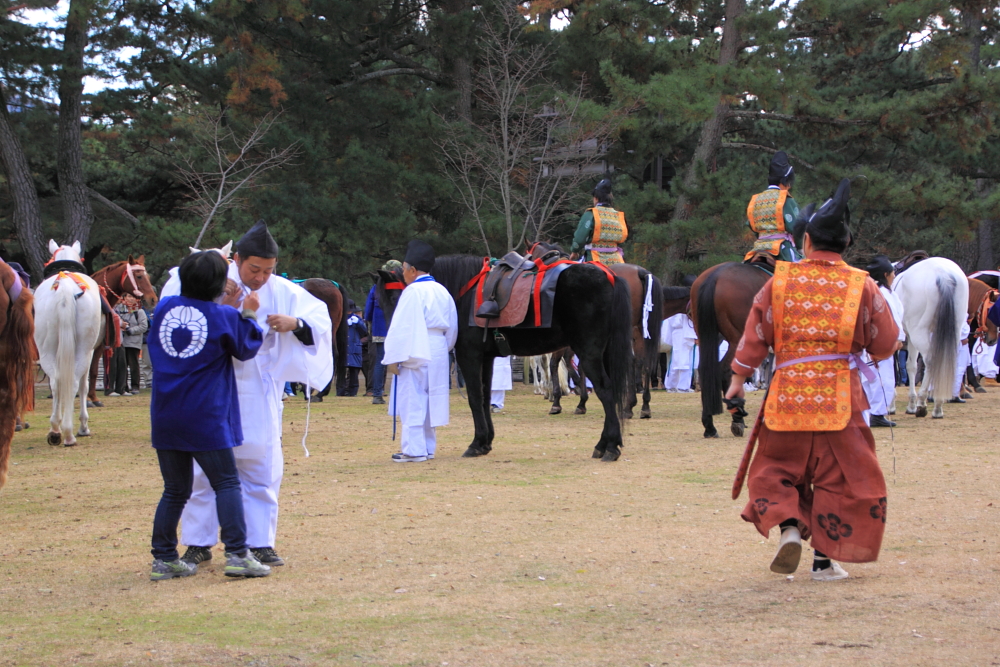
Just before the procession starts, the participants are gathering. Some of them are tense and others are relaxed.


He is rechecking the itinerary of the festival.


The other main characters are horses. Some of them are really excited.


On the 15th December, the costumes for the festival are exhibited.

At the same day, a shrine maiden performs "Boiling Water" ritual to invite the local deities
to pray to them for the success of the festival.

May all bad things be gone with 2011 and all good things come with 2012.
I wish your Merry Christmas and Happy New Year!