October 20, 2012

Cosmos in Cosmoses

Already Nara is in the middle of deep autumn. Everyday, the air is getting transparent and crispy more and more. I am enjoying the most comfortable time of the year!

I visited Hannya-ji Temple (般若寺) in Nara. This temple is well-known as Cosmos Temple. The history of the temple is said to date back to the 7th century.
 The main hall of the temple looks as if it were floating 
amid 150,000 cosmos flowers of 35 species.


Cosmoses are flowers native to Mexico. Around the end of the 18th century, the seeds of the flowers were first brought to Antonio Jose Cavanilles, the chief of Royal Botanical Garden in Madrid , Spain from Mexico. He named these flowers "Cosmos bipinnatus"

The word origin of "cosmos" comes from Greek word "Kosmos" which means order, harmony and the universe.  Maybe, people have seen the harmonious and well-ordered beauty in the flowers also.  Cosmetic or Cosmopolitan are derived from "cosmos".

For me cosmoses are difficult flowers to take photos.
Often they are very photogenic, but suddenly they turn photo-shy.


Among lovely flowers, the stone statues of Buddhist deities appear and greet us here and there.


How peaceful their archaic smiles are! Maybe they are whispering us
about the Buddhist cosmos in the middle of the  waves of cosmoses. 


Hannya (般若) means the wisdom of Buddha to see the truth.  The name of Hannya-ji Temple means this.

Interesting enough, Hannya has another meaning. It is said in Japan if a woman is so jealous, she transforms to a  female demon with two horns,  which is also called Hannya(般若).  This is a  mask of the female demon tormented by jealousy. The mask is used in Noh plays. As this type of masks were made by Priest Hannya first, so that they have been called Hannya.

My related blog
Most Beautiful Jealousy
Heart Sutra

Zizo Bodhisattva, a guardian deity of people especially children, wears a red bib where Heart Sutra (Hannya Sin Gyo, 般若心経) is written.  Heart Sutra, composing of  276 Chinese characters, is one of the shortest sutras. But it shows the essence of Buddha's teachings. Listening to Buddhist priests  chanting this sutra is soothing and brings me the peaceful state of mind.


 The thirteen-storied stone pagoda in early sunset.


大空の 青きとばりに 寄りそひて

人を思へる こすもすの花

与謝野晶子

Snuggling up to the blue shroud of the wide sky

Longing for someone

Cosmos flowerers

By Akiko Yosano (1878 - 1942)

She is one of the greatest poets. Her poems are characterized by a fiery passion and love. Surprisingly enough, she changed so neat and clean flowers into so passionate ones!


a dragonfly and cosmoses

参考) 季節の花事典、 麓 次郎 著、(株)八坂書房 発行所


October 09, 2012

Nostalgia in Asuka

This is Inabuchi(稲淵) area in Asuka.

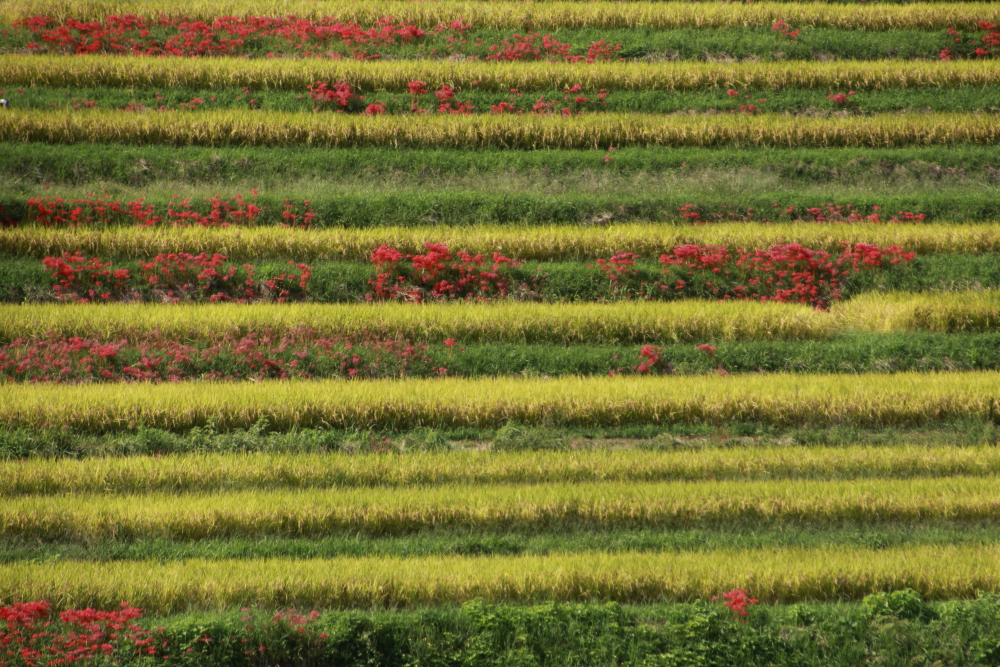
A beautiful countryside landscape evokes nostalgia. Golden ears of rice shine under a high autumn sky, and cluster amaryllises are in bloom at the edges of the paddy fields.


I visited Inabuchi area,  Asuka in Nara Prefecture. Asuka, the ancient capital of Japan, is famous for terraced paddy fields and ancient burial mounds. This soothing scenery never disappoints me. I deeply breathe in fresh air and fully feel recharged.

I saw a lot of dragonflies. 

The paths are lined with lovely scarecrows.
 Orthodox scarecrow 

My favorite. Father and Son are enjoying Sake rice wine after working in the fields.

Inabuchi is well-known for fascinating terraced paddy fields, but also backed by a lot of charming bamboo groves. The contrast of the bamboos in the sun and in the shade was beautiful. While I was taking photos, one bamboo in the shadow was glistening for about ten seconds or so. It was a mystery!  I imagined Princess Kaguya in "The Tale of the Bamboo Cutter" might have came down to the bamboo from the moon.

Since ancient times Japan has been called beautifully "Mizuho no Kuni (瑞穂の国), Land Blessed with Abundant Rice"where the people have been growing rice for more than 2000 years. Freshly boiled  pearly rice is the best delicacy and the symbol of happiness.  When I feel down, steaming boiled rice gives me a power to recover. Rice is the only one product whose self-sufficiency rate is 100% in Japan.


This area is blessed with rich sources of water.

It is hard to imagine why Cluster Amaryllis flowers are associated with ominous images.  The flowers have a lot of different names in Japanese. According to Wikipedia, they are called, flowers of the dead,  ghost flowers, hell flowers,  flowers of abandoned children and so on. 
But, also they are appreciated as celestial flowers. I agree with this 100%!

I am fascinated by this delicate  beauty.


Asuka is also the cradle of  Buddhism of Japan.  In 538 or 552, Buddhism was officially  introduced to Japan through  King Song (聖明王) of Korea who sent Buddhist statues and sutras to the Emperor.  Whether or not  Buddhism should be accepted in Japan, pro-Buddhist party led by the Soga clan (蘇我氏) and anti-Buddhist party led by the Mononobe clan (物部氏) fought against each other. After 35 year struggles,  the pro-Buddhist Soga clan won the war. This war is often said to have been the religious war, but also it is said that actually two powerful clans struggled for supremacy. In Japan religious wars have been rare. In 596, Soga no Umako (蘇我馬子), the supreme leader of the Soga clan, built Asuka-dera Temple, the first Buddhist temple in Japan.


This is called "Ishi-butai 石舞台" , which literally means "Stone Stage". This stone stage consists of about thirty granite rocks and weighs about 2300 tons. This Stone Stage is believed to be the tomb of Soga no Umako who was the most powerful man at that time and  built Asuka-deraTemple, the first Buddhist temple in Japan.


Around Stone Stage, Japanese sliver grasses are shining in the sun and beckoning us.

The spikes of the grasses look like sparkling  jewels.


my related blog, Nostalgic autumn.

September 25, 2012

Autumn Flowers in Bloom!

Every rain makes  autumn deeper.
After rain,  Kasuga Mountains are folded in mist and look like an ink-wash painting.

Not yet landscapes are colored with autumn foliage, but a lot of autumn flowers are blooming.

I visited Gango-ji Temple, 元興寺 in Nara-machi.

Cluster amaryllis flowers and Jizo statues

 I have seen the chief priest of this temple taking care of plants many times. Under summer sun, he was stubbing weed and watering flowers.  Maybe, the seasonal flowers are the fruits of his  affection and commitment to them.

Cluster amaryllis flowers are in bloom by stone pagodas and stone statues of Jizo Bodhisattva who is a guardian deity of people, particularly of children.


In Sanskurit, the flowers are called "Manjusaka" (Manjushage  曼珠沙華 in Japaneses) which means celestial flowers.

Although the bulbes of the flowers are toxic, how gorgeous but how serene the flowers are!!  I am enchanted by their subtle elaborateness.


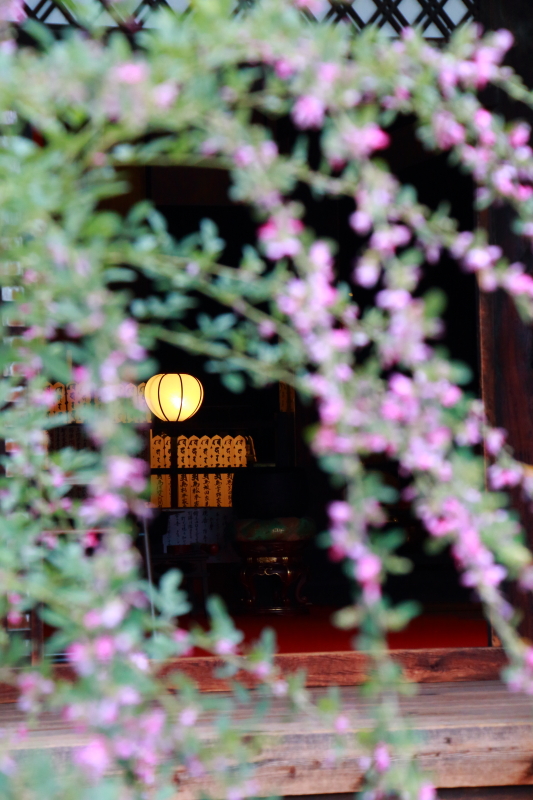
Bush clovers also are blooming in the temple.


"Nostalgic Autumn"(my related blog).  photo was taken in September 2011 in Inabuch.
Last year, I visited Inabuchi, Asuka, Nara Prefecture.
How gorgeous the combination of the paddy fields and Cluster amaryllis flowers is!!.

Nara Park is peaceful as usual.

posing with deer antler hair bands

Glory and Tragedytells you the history of this temple with blooming Harushagiku  flowers or coreopsis.
In summer, Nara become Town of Prayers is about  ""Obon(お盆)" and  "Jizo-bon or Jizo-e " festival

September 17, 2012

Land Blessed with Rice


Photo taken in October, 2011

In ancient times, Japan was beautifully called "Mizuho no Kuni"(Land Blessed with Abundant Rice).

In summer, green blades of rice wave in the breeze. In autumn, golden ears of rice bow and shine in the sun. This scenery enriches the Japanese soul.


                                     Photo taken in October, 2011

The harvest has begun and new rice will be in circulation soon.

Across Japan,  we see a sight  where vast areas of blooming flowers appear in the middle of paddy fields. This is the result of rice paddy reduction policy practiced by the government to prevent the price of rice from taking a drop by oversupply of rice, and to protect the rice farmers. Being supported by the government, some farmers have stopped growing rice. Using these fallow rice fields, flowers are planted but not for sale.

At the ruins of Moto Yakushi-ji Temple built around the end of the 7th century,
 purple water hyacinths are in full bloom. 
The flowers were planted by the pupils of a local elementary school

People enjoy the massive beauty of flowers, walking through the fields and taking photos.


Whenever I see this kind of flower fields of water hyacinths or cosmoses , I have ambivalent feelings.

That the flowers pleasure the eye is better than that the fallow rice fields remain abandoned.
But, many countries in the world are suffering severe shortage of food. At such a time, is it right thing to do to practice the rice paddy reduction policy?

The government has put the tariff of 778% on imported rice. Because the high-priced Japanese rice can't compete with cheep imported rice. There is talk of rice liberalization which will drive Japanese rice farmers out of business.

Rice is more than staple food in Japan. It has been the soul food, being deeply connected to our daily life and associated with Japanese culture or Shinto which is indigenous religion of Japan. Without rice, Japan would have been a different country.

The foundation stones of the temple building

In the early evening light, the wings of  dragonflies shine in gold.


No people but me. The ruins are wrapped with shroud of darkness.

Visit Weekend Reflections and see more!