Showing posts with label Mt. Wakakusa. Show all posts

February 13, 2013

Funny, Stupid, But My Favorite


In Nara Park, there is an unique contest! You will never be able to find like this even if you search for it all over the world.  It is  "Deer Cracker Throwing Contest" which is held a few times a year on the hillside of Mt. Wakakusa, Nara Park where wild deer live and mingle with people.

The participants of the contest throw a bigger deer cracker than usual and compete the distance. But,  you can imagine what will happen as soon as a cracker is thrown. The cracker comes apart and goes into the stomachs of the deer as soon as it lands on the field. It is difficult not only to throw a super-light cracker but also to measure the distance.This contest is very very funny and stupid, but I love it very much!


The first contest of this year was held on 26th January, it was windy day. All day long strong winds blew and violent gusts of winds curled. Sometimes a cracker returned with a strong wind like a boomerang. One woman got the poorest record, minus 5 meters. The winner  was a man whose record was 36.8 meters. He was awarded with a trophy of deer antlers!

The followings are interesting dramas between people and deer!

In winter, January 2013.
 Glacial winds numb his or her hands. But all of People and deer are enjoying and happy!


In summer, August 2012.
           Always before a contest starts, many deer are waiting ! In August, 2012. 


Carps in a pond are half hibernating.

But, in an icy air, the sunlight shows the promise of coming spring.

"Happy Valentine" from the deer with white hearts, in Nara Park.

February 01, 2013

Sign of Spring, Grass Burning Ceremony


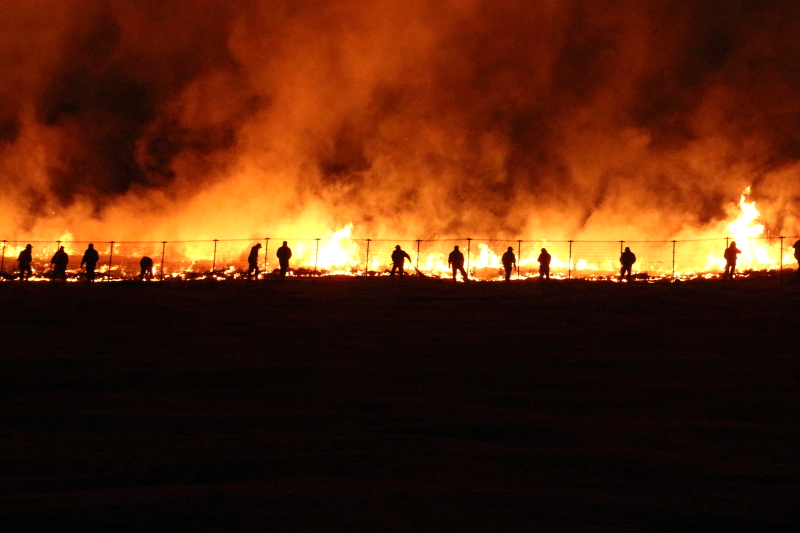
Every year , "Grass Burning Ceremony" in Mt. Wakakusa is held on the forth Saturday of January. This ceremony is the most spectacular and popular event in winter Nara. This year it was held on 26th January.

Since ancient times, fire has long been used for purification and cleansing both in Buddhism and Shintoism in Japan.

There are many spots to enjoy watching the event. I watched it at the foot of Mt. Wakakusa.
  300 firefighters are ready for "Grass Burning Ceremony" with their fire engines.

Before the ceremony, a dancing entertainment is  held on a temporarily built stage.
 "Passion"


Elegant and exotic with Chinese fragrance.

Sento-kun is a holy boy with deer antlers, who was chosen as a mascot for the 1300th anniversary of the transfer of the capital to Heijo-kyo Nara in 2010.
 Now he is a super star.!

The sacred fire is carried to the foot of Mt. Wakakusa.  They make a bonfire. 

The Buddhist monks of Todai-ji Temple and Kofuku-ji Temple, and Shinto priests of Kasuga Grand Shrine perform a small ritual.

A number of fireworks are launched. They are so big!! 

300 firefighters set the mountain on fire.


Huge walls of fire and smoke appear and overwhelm us. Walls are swelling and swirling,
 being buffeted by gusts of wind.  What a dynamic scenery it is!!
The area of 33 hectares is burnt down in 30 minutes.

"Grass Burning Ceremony" dates back to 1760. But its origin is not clear. One theory says the mountain was set fire to solve the boundary dispute between temples and a shrine near the mountain. Other theory says someone started to set fire to console the ghost's spirit which haunted around a small tomb on the top of the mountain. Also it is said that the mountain was burnt to drive away wild boars. 

People in Nara see every phase of seasons in every festival or ceremony. "Grass Burning Ceremony" has long been seen as  a harbinger of spring.  The subtle hint of spring exists even in the icy air. When spring comes here, fresh sprouts will spring up out of the ashes.  To burn the mountain is also for rejuvenation of the mountain.

My related blog,  "Fire for Purification".(Click here.)


On 28th January, two days after the ceremony, Nara Park was covered with snow.
 Mt. Wakakusa is over there.


May 28, 2012

In every wood in every spring there is a different green

May is the best season of year when we can enjoy the numerous hues of burning green.  
One day I walked a nature trail to Mt. Wakakusa through the Kasuga Primeval Forest of Mt. Kasuga in Nara. Kasuga Grand Shrine is at the foot of Mt.Kasuga.

This is a cozy tea room in an old Japanese style, surrounded with fresh maples.
 Here is the start point of the nature trail.

  On its thatched roof, baby maples are growing.


The extensive forest in Mt.Kasuga is considered sacred, so no one is allowed to cut down the trees or hunt animals. Now this primeval forest nurtures many kinds of plants, animals and insects as a sanctuary for the living beings. The forest was designated as a UNESCO World Heritage Site in 1998.

In every wood in every spring there is  a different green.


The sunlight softly slants through the overlapping leaves. The entire forest looks like a natural cathedral with shimmering emerald stained glasses and  graceful canopies. When a breeze blows over the green canopies, flickering sunlight through the  leaves quietly falls on me. I feel as if I were in the bottom of the sea and looking up at the surface of water. What a  pleasant and soothing moment it is!


 This is the top of Mt. Wakakusa,  Mt. Young Grass,  where  "Grass Burning Festival" is held in January every year.

In every wood in every spring there is  a different green.


When I came back to the start, the charming cafe was closed already.

I got to know this words "In every wood in every spring there is a different green."
 ("I sit and Think" by J.R.R.Tolkien, the anthor of  "The Lord of the Rings".) through Professor Sheffner (his blog).  Also last year he left the similar comment  on my blog "Everything is Bathed in Green Breeze, Isui-en Garden". "In every tree, in every wood, there is a different green" (Bilbo Baggins in "Lord of the Rings").

I have been deeply inspired by the words of Tolkien. For me, his words seem to depict the essence of life in spring green and its mysterious energy.  This spring, I visited a several places to find out the green mentioned by Tolkien.  It was somthing like a quest or pilgimiage with no religious meanings. But, I felt it was enough to visit even only Mt. Kasuga and its forest. Every place had its own unique shades of green.