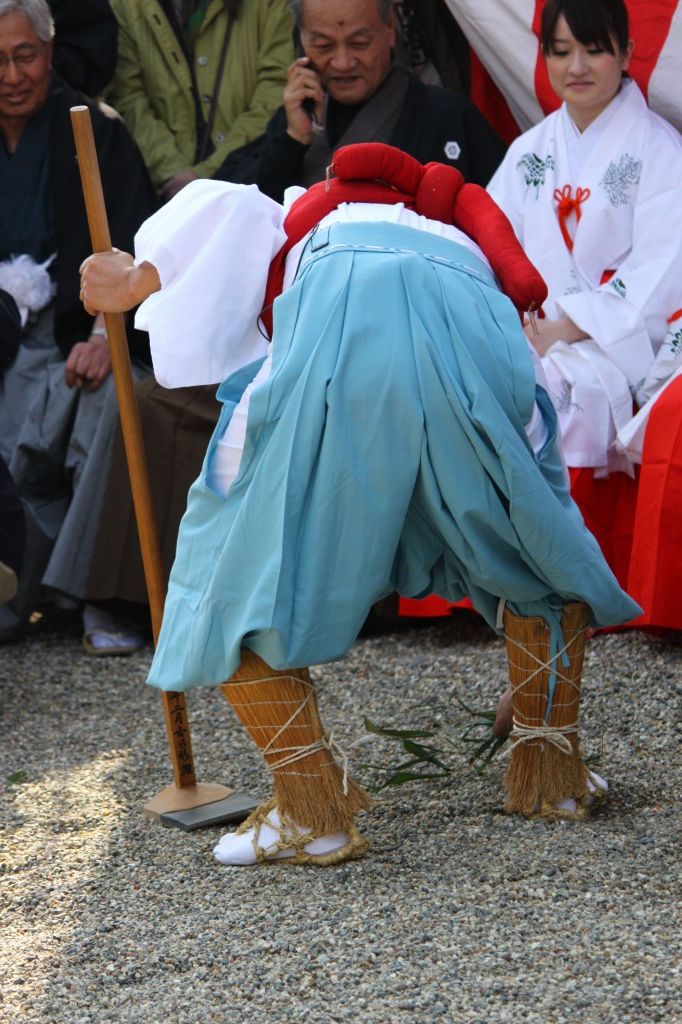
This is the most exciting and mysterious ceremony full of legends !

Real spring comes to Nara after "The Second Month Ceremony" is over. In February Hall of Todai-ji Temple, this ceremony has been held for 1260 years without interruption since 752 when the temple was built. The ceremony is held from March 1st through 14th.
This is February Hall. On the left there is a roofed stone staircase
leads to February Hall with a balcony.

the stone staircase viewed from the balcony

People are waiting for the start of the ceremony under the balcony.

Every evening, ten of the eleven priests climb up the stone steps to February Hall
one by one, each of them guided by an attendant.
one by one, each of them guided by an attendant.
Each attendant carries a huge flaming torch made of a big bamboo
with cedar branches attached at its top. The biggest torch is 8 meters in length
and 70 kilograms in weight.

From the balcony of the hall, each attendant swings and spins the flaming torch.

Then he runs across the balcony.


The torch is huge!

At the other corner of the balcony, he swings and spins the torch again.

The breathtaking shower of flying sparkles from the torch
fall down on people like a cascade!
fall down on people like a cascade!

How exciting they are - the smell of scorched cedar leaves, the sound of sparkling wood and flowing down sparks over people! Now they are involved in a huge ripple of excitement. According to one theory, this ceremony was influenced by Zoroastrianism which was introduced to Japan along Silk Road.
If they get sparkles or embers, they are promised to be healthy throughout the year.
They bring the embers or cinders home so that their prayers and wishes will be answered.

Torch Ceremony" is so famous that people are apt to think it is "Second Month Ceremony". But
" Second Month Ceremony" consists of many rituals precisely scheduled. "Torch Ceremony" is one of them. The ceremony is also known as "Water Drawing Ceremony" based on the mysterious legends. However, the true essence of " Second Month Ceremony" is repentance. Six times a day, the eleven priests perform repentance rite in front of the eleven- faced Kannon Bodhisattva. They pray to the Kannon for happiness, peace, good weather and abundant harvest on behalf of people all over the world. These pious prayers reflect the current affairs. On Great Hanshin earthquake in 1995 or 9/11 in 2001, eleven priests prayed for the souls of the dead and for that it would never happen again. Behind the white curtain, eleven priests are holding the rituals in front of eleven-faced Kannon.

Even though Todai-ji Temple is a Buddhist temple, this ceremony is said to be the assimilation of Buddhism and Shinto- indigenous religion of Japan. Every night, the priests call a numerous number of Shinto deities' names and invite them to guard the ceremony. Shinto deities come to gather around February Hall from all directions. Now this place becomes the most sacred place in Japan.
February Hall is protected by boundaries too. The boundaries are stretched
here and there to drive away evil and protect the hall.
White paper is for Shinto and green leaves are for Buddhism.
here and there to drive away evil and protect the hall.
White paper is for Shinto and green leaves are for Buddhism.


At the entrance of the stone staircase, the torches are placed on the walls.
Before Torch Ceremony on Marchy 2nd .

AfterTorch Ceremony on March 2nd .

An elderly man standing next to me said ," This ceremony is so addictive that it makes me feel like coming here everyday!" I felt deeply that the fusion of Buddhism and Shinto can not express the nature of this ceremony well. It transcends Buddhism or Shinto, and it is something like the hometown of people's heart.
On the way to February Hall, I saw a stall vending baked sweet potatoes.
It is difficult to resist the tempting smell.


Visit My World site and see more !