February 05, 2011

Horn Gather Antlers

One man quietly appears at Tobihino field in Kasuga Grand Shrine, Nara Park, and starts to play Beethoven's Symphony No. Six on the horn. Being drawn by the sound of the horn, more than 100 deer rush toward him from all directions!!
You will wonder whether the deer in Nara Park love a classic music or he is a Pied Piper ??  The deer are beckoned by something else. Acorns!

This is known as "Deer Gathering"(鹿寄せ). During winter less grass and less natural food are available, so the deer suffer from food shortages. From February to the beginning of March "Deer Gathering" is held to feed acorns to the deer.

It's over. Let's go home! 

Interesting reflections on the horn, but it has many scratches on it as the deer push and shove it.
The scratches are the history of this horn.

This is Nara Park in summer where fresh grass is everywhere!

This event started in 1892. However, this practice was suspended during World War Ⅱ. In 1949, the sound of the horn came back to Tobihino field. Since then  annually Beethoven's Symphony No. Six has been played on the horn.

Let's me introduce an interesting episode. On February 11th, 1979, Nini Rosso, a world-famous trumpeter came to Tobihino field from Italy. He had been curious whether the sound of a trumpet would be able to gather the deer. He started to play Symphony No. Six on his trumpet. As soon as the melody was absorbed in the wood,. he saw the deer jumping out of the woods one by one.  He was amazed that the deer had a good ear for music.

Besides the most eye-catching thing about the deer is that they practice Japanese custom - bowing to people as we bow when we greet.

In Nara Park there live about 1100 deer. All of them are wild animals and considered as holy messengers of Kasuga god.
 my related blog "I captured a moment".
                                 
                                                        Click to see the rules and to take a badge for yourself.

January 30, 2011

Fire for Purification

Every year Mt. Wakakusa in Nara is set on fire in January. But, why?

The origin of  "Mountain Burning Ceremony"  was  based on a ghost story. According to an old story, a ghost haunted around a small tomb on the top of the mountain and scared people. So, they decided to burn the entire mountain to console the ghost's spirit. Since then, every January Mt. Wakakusa Burning Ceremony has been held.  In Japan fire is used for purification both in Shinto( indigenous religion of Japan) and Buddhism. This ceremony dates back to 1760.

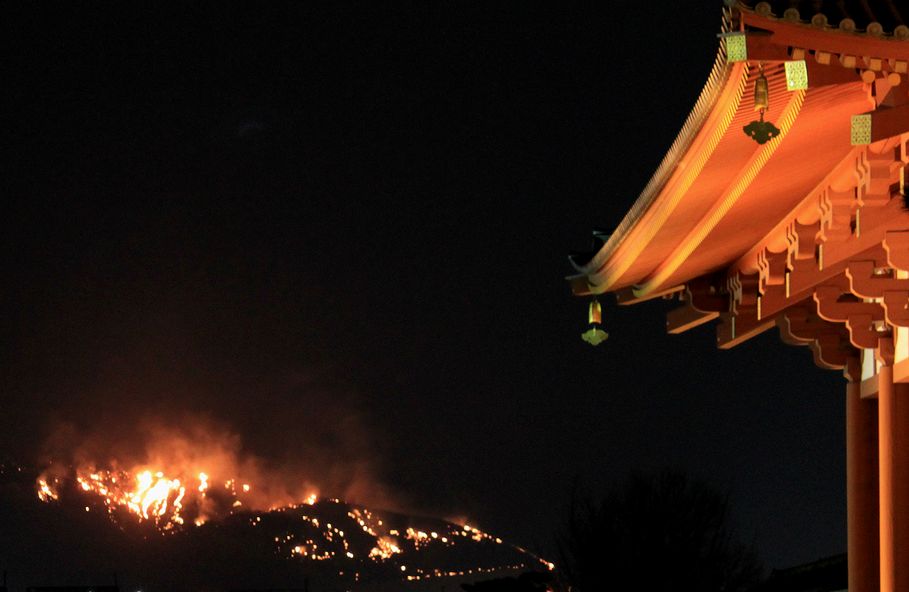
 I visited  Heijo Palace Site,  which was the center of Japan in 8th century, to enjoy viewing the ceremony. This year it was held on January 22nd.

                       In east, night started.
This structure is the reproduction of the ancient  Imperial Audience Hall.

                                             But, in west, still sunset stayed.

Six hundred fire works  were set off  and adorned the night sky.

The entire mountain was set ablaze.


On the way back to the station, I found a tranquil  reflection in a pond.


Click to see the rules and to take a badge for yourself.


January 16, 2011

Japan's Future Smiling With Hope !


It was a cold winter day, but here was a spring-like pomp of the new adults who reached the age of 20. ( January 10th was Coming-of-Age Day.) 


Do you remember the day when you reached the age of 20?  I smiled like them and believed dreams would come true.

Coming-of-Age Day is a national holiday held on the second Monday of January -  January 10th, this year. Local governments hold large-scale ceremonies for all the young men and women who have turned 20 in the previous year.  At the age of 20, they get the right to vote, smoke, drink and marry without their parents' permission. Most of  women wear formal kimono with long sleeves, while majority of men are dressed in suits.  This is the day when all over Japan are filled with myriad of colors of kimono.

The number of the people who came of age in 2010 is about 1.24 million and is less than 1 percent of the total population.

 The new adults were born in 1990 when in Japan the bubble economy was going to burst and in the world Iraq invaded Kuwait to lead to the Gulf War.

Japan has been going through many difficulties and they are the generation who are to shoulder the burden of the country such as the huge national debt, the increasing pension premiums, medical costs, aging population, and more. I feel very sorry for them but it is impossible to choose the time to be born.

Let's stop seeing the negative side. Standing just at the threshold of the adulthood,  how thoroughly delighted they are!  They are the Japan's future smiling, brimming with hope!! I'm sure they will courageously confront the issues.


They are also the generation who are always tapping on their mobile phones and updating the information in their social network. They have the amazing ability to make free use of IT or digital devices. People, my age never catch up with them.

The new adults are interviewed by a reporter of a  newspaper company.
 We see the amazing fusion of the traditional and the modern  here and there!

   Bon voyage! May their smiles and happiness last for a long long time!          


January 08, 2011

Heavy Drunk・・・ in Noh Play

I had never expected to see a heavy drunk in Noh.

 He is "Shojo(猩々)". "Shojo" is the title of the Noh play as well as the name of  a legendary creature who lives in the water and loves Sake, Japanese rice wine, very much. His red face tells us he is a heavy drinker.

 When I was a teenager, my mother took me to a Noh theater.  It was the first time for me to  enjoy Noh play. The theater was very comfortable and cozy, and Noh performance was very slow as if  sculptures were walking. Chanting the story and playing Japanese traditional musical instruments sounded like a soft lullaby. All of the art helped me feel drowsy.  I fell asleep and scarcely  remembered what I saw.

Since then I had had stereotype of Noh plays," Noh is highly stylized theatrical art, I know, but  not exiting. Movements are too slow and the language is too  hard to understand. Noh is for the people as old as my mother."

"Shojo" completely overturned my stereotype of Noh.  "How exciting Noh is!!"

He is a good drinker, but drinks like a fish. More sake he drinks, happier he becomes.
 Now he is dancing joyfully.

He shows a number of funny drunken behaviors. Does he remind you of anybody,
 your husband, father or brother when they are drunken?


He stumbles and loses his balance. 

At last, he collapses. 

 In olden days Noh was performed on an open-air, simple stage like this. The sun, the sky, clouds, trees, everything around the stage become the effective stage backdrops. Clouds cast mysterious shadows time to time. A gust of the wind brings murmurs of the trees. Crows fly over the stage cawing. 

A deer also comes to enjoy Noh play.
 

 To perform "Shojo" is  auspicious. Why is the Noh play of a heavy drinker auspicious? I suppose sake is involved in  almost all ceremonial and happy occasions. So, to have sake is associated with happiness and joy.  Also Sake is  a very important item to offer to Shinto deities every day. That's why "Shojo" is considered as an auspicious play.

After watching Noh,  I pondered for a while. When I was young, I lived fast and loved something exciting. Now,  I am older than my mother at that time and  I became to enjoy Noh. Is it  because of my age or the exciting play?

Nara is said to be the cradle of Noh as the original  four schools of Noh were born  here. In olden days, the prototype of Noh would be performed  in front of a shrine as  the offereing to Shinto deities.

December 24, 2010

Reflections・・・ at Kyoto Station

 Kyoto Station is a futuristic building designed by the architect Hiroshi Hara. The station, soaring 60 meters high up to the sky, was completed in 1997.

The main concourse is amazingly spacious; 50 meters high, 147 meters wide, 29 meters deep. Through the ceiling, the art of steel and glass, people see the sky color changing over time and feel the transience of time. I appreciate it as the building has the Japanese traditional way of sensing the subtle change although it is a masterpiece of futurism.  At sunset the ceiling seems to glow a pale pink. The combination of the sunset, the high ceiling and the huge space is inspiring. This perfect setting also reminds me of a solemn cathedral in Europe.

What I enjoyed the most are the beautiful reflections. All the pictures in this blog, except one, have the reflections.
The huge glass facade  mirrors the sky, clouds and Kyoto Tower.
 These are intriguing mirror images. You will  wonder, what you see  is real or not.

He seems to be going to fall from the edge of the top. His image is also a reflection.

Twins of Kyoto Tower
                                                    
 Grand Staircase is the soothing area where people sit down to take a rest, eat  or enjoy doing nothing.

Over the main concourse is an aerial walkway connecting the east and west wings,
 and giving a magnificent view of the city.
  
Although more than ten years have passed after the construction, this building is still half praised and half criticized by people. As Kyoto is the ancient capital where the emperors had lived more than 1000 years, the architectures in the city are expected to harmonize and unify with its long history and unique culture. Some people think the station is too modern. But, I really like this building which is the ideal  fusion of the modern and the traditional.


In front of the station is Kyoto Tower which also has been the subject of controversy since it was built. It isthe similar case with the station.

Kyoto Station is one of the most important transportation hubs served by train lines extending throughout Japan.
Why don't you come and explore the station which is the ideal starting point of your journey to Kyoto.
I'm sure you'll like it!


                                             Click to see the rules and to take a badge for yourself.


December 18, 2010

Merry Christmas at Nara Park !

In the late afternoon of a gentle winter day, I happened to meet this scene.


 A deer has just arrived at the edge of a pond to drink water. A father is taking pictures of his family, lying on his belly over a rock. People are talking and walking. Children are smiling. The pond quietly mirrors the peaceful scene. Over them, soaring up to the sky is a dawn redwood,  turning reddish-brown and watching people.  It looks like a natural Christmas tree.

When I encountered the tranquil and  soothing scene,  I could not help murmuring,
  " Merry Christmas !."


                             Click to see the rules and to take a badge for yourself.