Showing posts with label Gango-ji temple. Show all posts

September 25, 2012

Autumn Flowers in Bloom!

Every rain makes  autumn deeper.
After rain,  Kasuga Mountains are folded in mist and look like an ink-wash painting.

Not yet landscapes are colored with autumn foliage, but a lot of autumn flowers are blooming.

I visited Gango-ji Temple, 元興寺 in Nara-machi.

Cluster amaryllis flowers and Jizo statues

 I have seen the chief priest of this temple taking care of plants many times. Under summer sun, he was stubbing weed and watering flowers.  Maybe, the seasonal flowers are the fruits of his  affection and commitment to them.

Cluster amaryllis flowers are in bloom by stone pagodas and stone statues of Jizo Bodhisattva who is a guardian deity of people, particularly of children.


In Sanskurit, the flowers are called "Manjusaka" (Manjushage  曼珠沙華 in Japaneses) which means celestial flowers.

Although the bulbes of the flowers are toxic, how gorgeous but how serene the flowers are!!  I am enchanted by their subtle elaborateness.


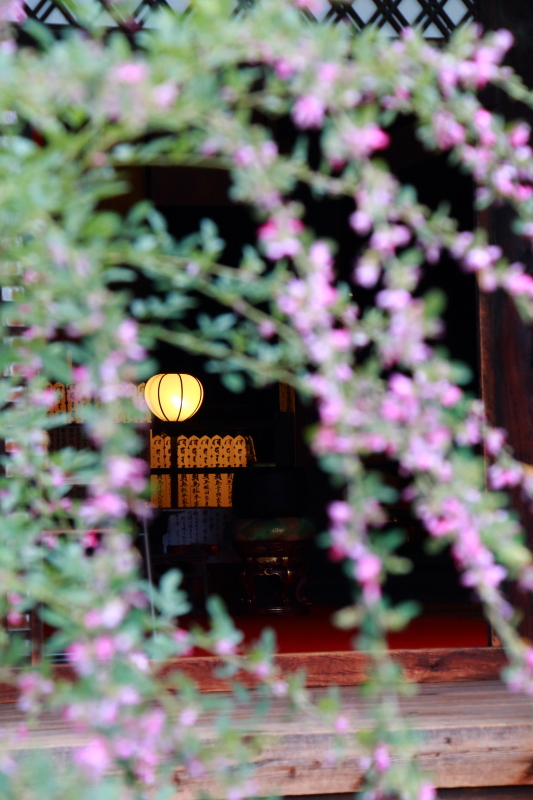
Bush clovers also are blooming in the temple.


"Nostalgic Autumn"(my related blog).  photo was taken in September 2011 in Inabuch.
Last year, I visited Inabuchi, Asuka, Nara Prefecture.
How gorgeous the combination of the paddy fields and Cluster amaryllis flowers is!!.

Nara Park is peaceful as usual.

posing with deer antler hair bands

Glory and Tragedy, tells you the history of this temple with blooming Harushagiku  flowers or coreopsis.
In summer, Nara become Town of Prayers is about  ""Obon(お盆)" and  "Jizo-bon or Jizo-e " festival

September 10, 2012

In Summer, Nara becomeTown of Prayers


 Every evening I enjoy comfortable temperature and a beautiful moon. In daytime, a coolness of Autumn is  gradually overwhelming a lingering summer heat.

Summer is a colorful season when a various festivals, ceremonies or rituals are held all over Japan. I would like to introduce two ceremonies based on  folk beliefs of Buddhism as my memory of summer in Nara.

One is "Obon(お盆)" and the other is "Jizo-bon or Jizo-e (地蔵盆 or 地蔵会)", both of them are held across the country.

 "Obon (お盆) " is the 3-day period of the year from August 13th to 15th when the spirits of the deceased return to this world to spend three happy days with their families.  The memorial services are held to dedicate to the spirits. Also "Obon" is a good chance for family gatherings or friend reunions. 

On the first day and the last day, Bon fires are made to welcome the spirits and then to say  Good-bye to them. I love this belief which gives me a quiet comfort. At least once a year the spirits of the beloved people will come back to see us from the other world. The poem or song "Do not stand at my grave and weep" 千の風になって",   like "Obon" makes  me feel soothing .

"Do not stand at my grave and weep" translated in Japanese


This is the "Ten Thousand Candle Ceremony, 万燈会" held for Obon on August 15th at
Todai-ji Temple 東大寺. Actually ten thousand candles are lit around Great Buddha Hall.


The window is open two times a year. The illuminated face of Great Buddha 
is welcoming us in a warm atmosphere. 


smoke from an incense burner

On a lantern, a prayer of a worshiper is written.

a fierce face of one of four directional divine guardians to protect Buddha.
Amazing! The artists used the rings very effectively. Sorry, the photo is not clear.

Many kinds of charms are sold in Great Buddha Hall.


This is "Jizo Bon, or Jizo-e (地蔵盆、地蔵会)"  held on August 23rd and 24th at Gango-ji Temple, 元興寺. This ceremony is dedicated to Jizo Bodhisattva who is a guardian deity of people, particularly of children. 

This lovely temple has a number of  stone statues or tablets of Buddhist deities or pagodas. 

 Dim glows of candles are flickering and create the peaceful pure land of Jizo.

In the precincts of the temple, there are many temporary stalls for food or games.


This temple is well-known for blooming seasonal flowers.
 Early summer Harushagiku or coreopsis are in full bloom.

Late summer bell flowers in bloom


There are five demons which live in this temple with Buddhist deities.


A crescent moon and crape myrtle flowers 

my related blog Glory and Tragedy


Visit "Our World" and see more!!
I linked this blog to Mandain Orange Monday, Visit and see more!!

June 21, 2011

Glory and Tragedy

Who knows this temple's glorious history? Who knows its tragic events?  Even people in  Nara know little about them.

It is Gango-ji Temple in Naramachi, Nara City. This lovely  temple always welcomes us with seasonal flowers. Now, Harushagiku or coreopsis are in full bloom.

Buddhism was introduced to Japan through Korea in 538 or 552. Over whether Buddhism would be accepted or not, the leading noble clans were divided into two parties; pro-Buddhist and anti-Buddhist. They fought against each other for decades. At last, pro-Buddhist party led by the Soga clan won the war. In 588,  the Soga family built the first Buddhist temple in Asuka (then Capital of Japan) and named it Hoko-ji Temple which is the forerunner of Gango-ji Temple. When Nara became the capital of Japan, the temple was moved to Nara in 718, renamed as Gango-ji Temple and flourished as one of the Seven Great Temples in Nara.
Stone carvings of Jizo Bodhisattva( guardian deity of children and travelers)
and stone memorial  tablets 

When I read "Japan" published by "lonely planet" which  is  the largest travel guide book and digital media publisher in the world , I was startled at the explanation about Gango-ji Temple.
"A small temple that is listed as one of Nara's UNESCO World Heritage sites. Despite its World Heritage listing, it's not particularly interesting and probably only merits a quick glace from outside." Oh, No!! (This book is the 10th edition in 2007. So if the latest edition amended its evaluation of this temple, I am awfully sorry.)
Stone carvings of Jizo Bodhisattva and  small  stone pagodas

Once upon a time, Gango-ji Temple  held  huge precincts and was as magnificent as Kofuku-ji Temple or Todai-ji Temple.

The temple had experienced the rise and fall.  The temple had suffered unfavorable issues and repeated fires. Especially, in 1451, the conflagration caused by an  uprising burned many temple buildings including the main hall. The temple did not have enough strength to rebuild the lost structures. People started to occupy  the land of ruins of the temple. They built  their houses, planted vegetables and made paths in the precincts of the temple. This is how Naramachi was formed. The size of the temple was badly diminished. But the temple holds the oldest history among the all Buddhist temples in Japan.

Among gray roof tiles, there are reddish brown roof tiles which are the oldest roof tiles in Japan, dating back to the 6th century. They have been still protecting the temple structures from the elements.

I found the stone called  "Stop Stone" which means the owner of the land refuses us to go forward over the stone. The stone is placed in front of the path to the private section of the temple. I like the stone better than a notice board  saying "Off-limit". If you see this kind of  stone in a Japanese garden with a tea house,  it is to guide visitors along a prescribed route.

Strange enough, the guardian of this temple has been Thunder Deity,  but over the years people started to mix the images of  Thunder Deity and a demon. The guardian really looks like the demon.

Now the temple is loved  and supported by people. This great little temple with the tranquil and cozy atmosphere is my favorite. How soothing !
Can you see it raining?


Visit My World to learn more about our world!!